A national affordable housing programme appears to be near the top of the agenda, run from No.10 North, but key details on the direction of travel of a Burnham government, and an idea on who’ll be taking the top jobs remain a closely guarded secret. We’ll need to wait to hear more on that, but as mayor of Greater Manchester his track record on housing leaves some reasons to be cheerful. So, can ‘Manchesterism’ translate on the national stage?
What Would a Burnham Housing Agenda Look Like?
His proposed national affordable housing programme, potentially run from a northern power base, suggests a decisive shift towards social housing expansion—a marked departure from recent governments' market-led approach. Even if (well-placed) scepticism reigns on how this would be funded.
Burnham's previous comments about bond markets have raised eyebrows, and his choice of Chancellor will prove crucial: a left-leaning appointment like Ed Miliband might unsettle markets already jittery about fiscal policy, potentially pushing mortgage rates higher and dampening buyer demand. A more centrist pick could ease concerns but would signal policy constraints that might limit his affordable housing ambitions.
The Manchester Track Record
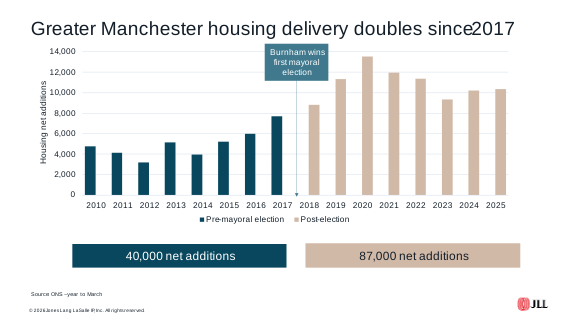
On Burnham's watch, Greater Manchester has delivered one in every 21 new homes built across England since 2017—up from one in 32 in the eight years prior.
Since Burnham's first mayoral victory in May 2017—he's won twice more since—Greater Manchester has averaged nearly 10,900 net additions annually. This equates to 79 per cent of its current housing need target, outstripping England's 62 per cent average. Between 2017 and 2025, housing delivery across Greater Manchester surged 116 per cent compared to the preceding eight years, dwarfing the increase nationally of 42 per cent over the same period.
In the eight years since April 2017 Greater Manchester recorded almost 87,000 net additions, more than double the 40,000 in the preceding eight years. Delivery increased across England too, although the move from 1.2 to 1.8 million net additions was more modest. If England had matched Greater Manchester's 116 per cent growth rate in housing delivery since 2017, we would have added, on average, an additional 120,000 homes per annum, bringing annual net additions to 350,000—just 20,000 shy of the government's 370,000 target.
Of course this wasn’t solely attributable to Burnham, with critics arguing he was in the right place at the right time to capitalise on the momentum which was clearly building. Wherever the truth lies, the results show Greater Manchester has seen higher economic growth and elevated housing delivery under Burnham’s tenure. Gross value added (GVA) across the metropolitan area—essentially the value of goods and services produced—shows Greater Manchester has experienced a 37 per cent rise since 2017, outpacing growth nationally of 10 per cent over the same period. Applying Manchester growth rate to national GVA implies a further £617 billion of additional GVA could have been created if the UK had followed a similar path to Greater Manchester’s.
Again, we need to be careful labelling this as the ‘Burnham effect’, with Greater Manchester GVA also outperforming the UK average prior to Burnham’s tenure. But the continued growth and ambition across the city have been palpable in the last decade.
Affordable housing
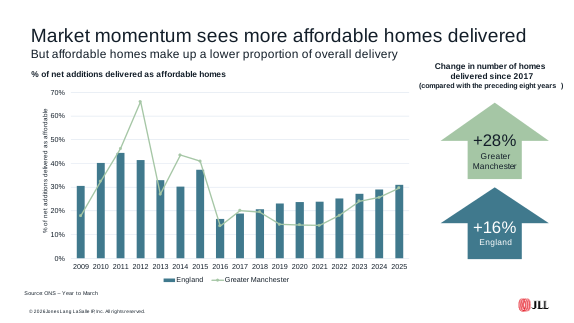
With Burnham pledging to build more social homes, his record on affordable housing will come under increased scrutiny. Delivery of high rise residential in the centre of Manchester and Salford has focussed on private sale or build-to-rent rather than affordable, a deliberate plan to bring younger professionals into the city core. But across Greater Manchester affordable housing delivery has totalled almost 17,000 homes between 2017 and 2025, around 19 per cent of total delivery. This lags the 25 per cent achieved nationally over the same period. But a higher percentage of a smaller number doesn’t mean more homes. Growth in affordable housing delivery still outperforms, with the eight years post the first Mayoral election in 2017 seeing 28 per cent more affordable homes delivered across Greater Manchester than in the previous eight, while nationally numbers rose 16 per cent over the same period.
The Scale-Up Question
It looks likely we’ll soon discover whether ‘Manchesterism’ represents a genuine blueprint for national housing delivery. Of course, local success doesn't automatically translate nationally, and a mayoral authority of 3 million people differs from governing more than 60 million across vastly diverse communities. Burnham's challenge will be replicating success whilst navigating parliamentary politics, Treasury constraints, and regional interests far removed from Manchester's urban development dynamics.
The residential sector faces genuine uncertainty. Bond market jitters and mortgage rate sensitivity could offset policy improvements. Planning reform that works in theory often stalls in practice and affordable housing programmes require sustained funding commitments that cross electoral cycles. Industry capacity itself poses limits, construction sector labour shortages, supply chain constraints, and planning department under-resourcing won't disappear with political will alone. Scaling Manchester's 116 per cent growth to national level demands infrastructure, skills, and institutional capacity alongside policy change.
JLL’s Residential and Living team consists of over 300 professionals who provide a comprehensive end-to-end service across all residential property types, including social housing, private residential, build to rent, co-living, later living, healthcare and student housing.
Disclaimer: © 2026 Jones Lang LaSalle IP, Inc. All rights reserved. Data within this report is based on material/sources that are deemed to be reliable and has not been independently verified by JLL. JLL makes no representations or warranties as to the accuracy, completeness or suitability of the whole or any part of the report which has been produced solely as a general guide and does not constitute advice. No part of this publication may be reproduced or transmitted in any form or by any means without prior written consent of JLL. JLL, its officers, employees shall not be liable for any loss, liability, damage or expense arising directly or indirectly from any use or disclosure of or reliance on such report. JLL reserves the right to pursue criminal and civil action for any unauthorized use, distribution or breach of such intellectual property