Higher for longer delays the recovery
Back in May we said the conflict in the Middle East had pushed out the chance of an improvement in mortgage rates, and six months on that view has hardened, with average two- and five-year fixed rates at around 6 per cent in November and fewer than 60,000 new mortgages approved in the latest monthly figures. Rates are factoring in elevated bond yields and the higher inflation now forecast for late 2026 and early 2027, with the Bank of England expecting inflation to reach 5 per cent by mid-2027, which means the short-term outlook rests on the path of inflation and rates.
Prices bottom out in 2027
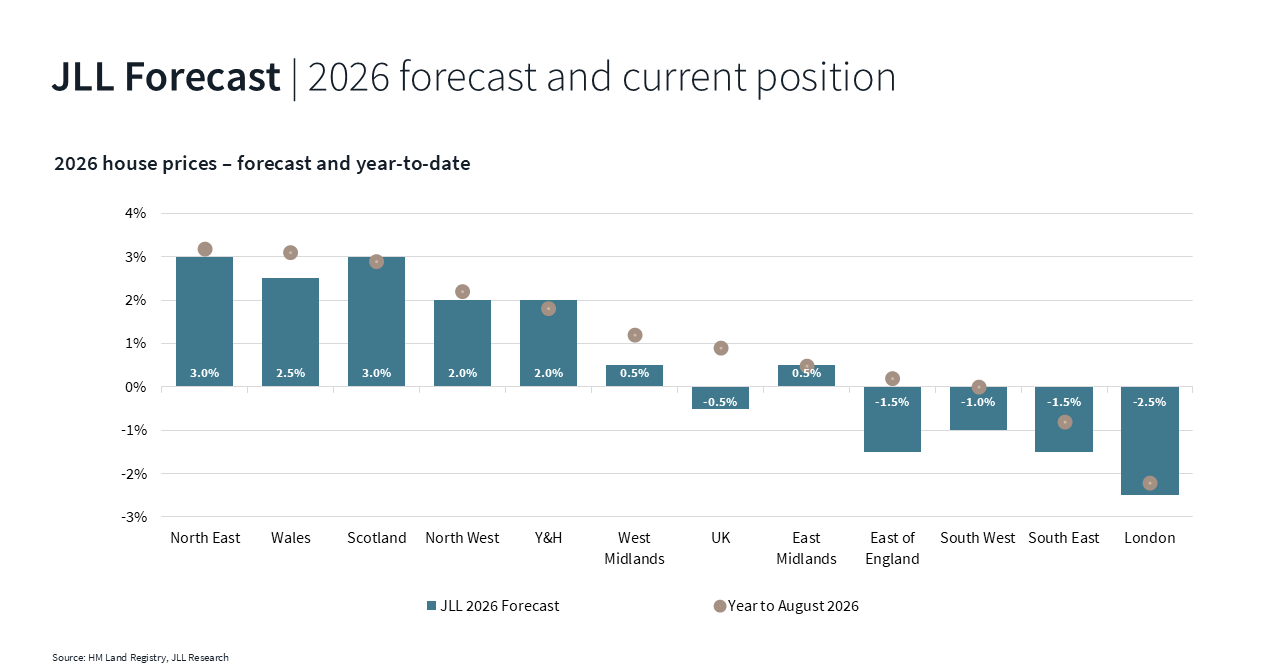
We've left our 2026 forecast unchanged from May, with UK prices ending the year down 0.5 per cent, London seeing the most significant falls and the North East and North West rising, albeit still only tracking inflation by year-end.
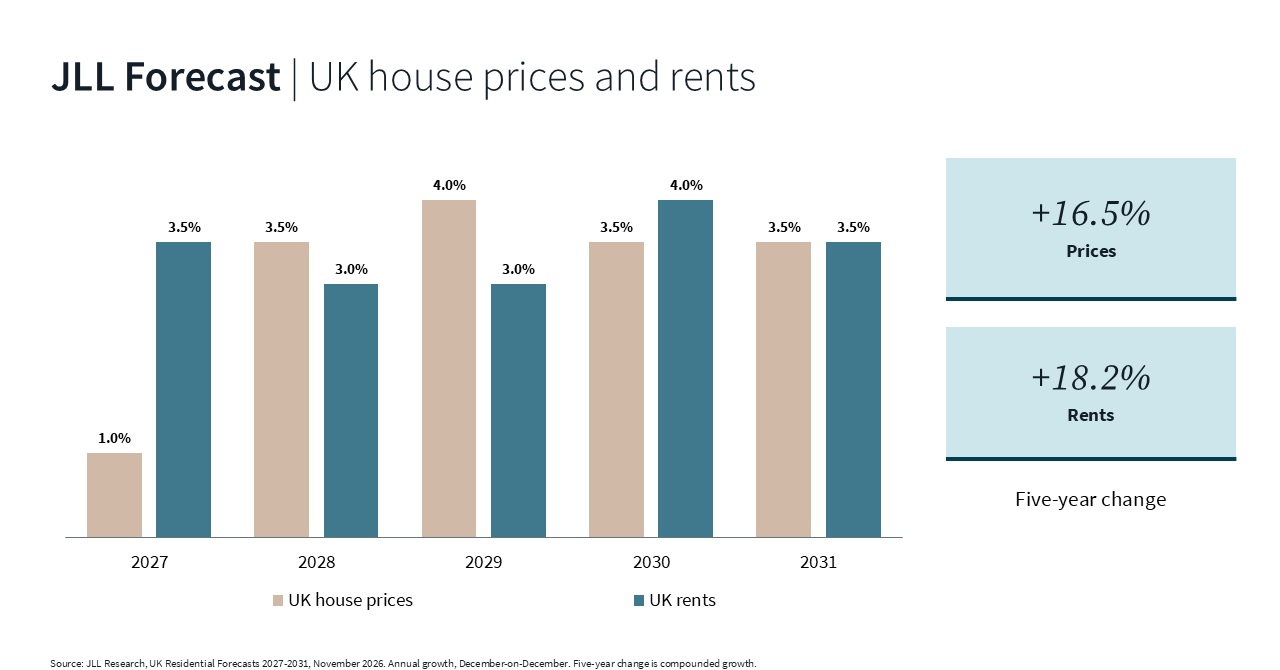
Higher rates and a more challenging economic backdrop mean 2027 will be weaker than we expected earlier in the year, with UK growth of 1.0 per cent against the 2.0 per cent we forecast in May, before the recovery builds to 3.5 per cent in 2028, 4.0 per cent in 2029 and 3.5 per cent in both 2030 and 2031, which compounds to 16.5 per cent over the five years, or 3.1 per cent a year.
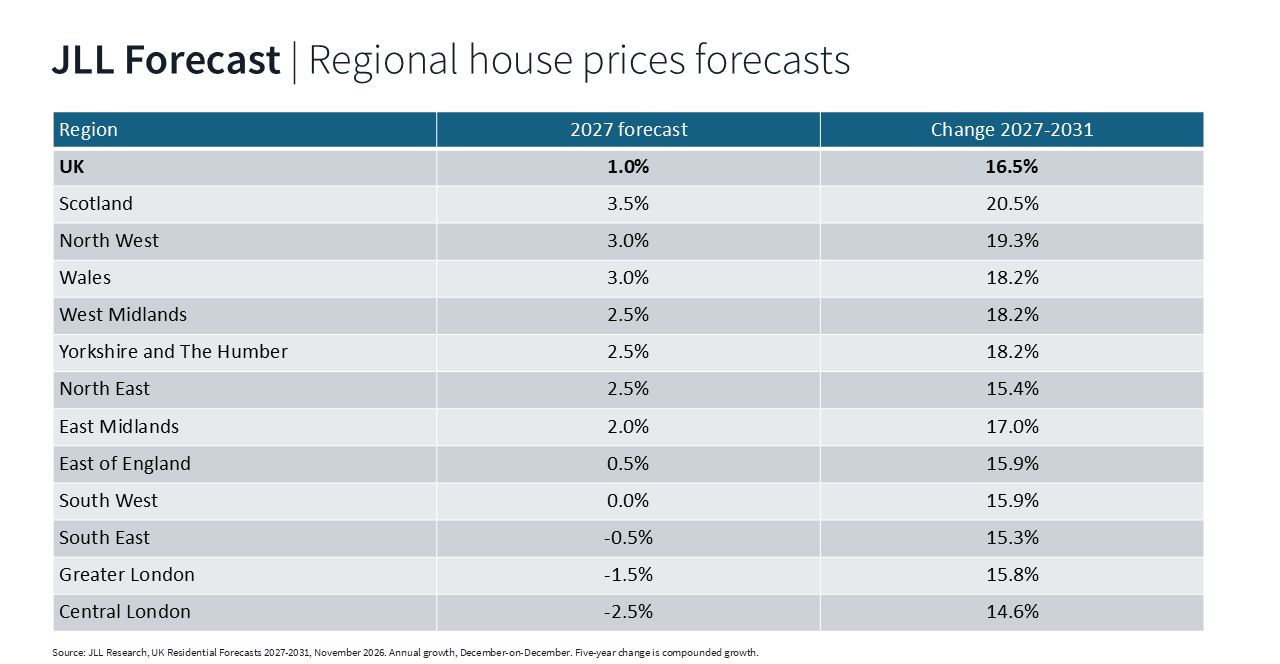
But conditions will remain tougher in London and the South of England, with prices expected to fall 1.5 per cent in Greater London and 2.5 per cent in Central London next year, 2.5 and 4.0 percentage points below our May forecasts, while the North West and Scotland lead with growth of 3.0 per cent and 3.5 per cent, although both will see prices broadly plateau in real terms. London's recovery is expected to be sharper once it arrives, with Central London growth of 6.0 per cent in 2030 and 5.0 per cent in 2031, though five-year growth of 14.6 per cent still trails the UK's 16.5 per cent.
We can't see transactions rising in 2027, with many of the pressures that have held back activity over the last couple of years set to persist, and we expect around 1 million homes to change hands, down from our 1.1 million estimate for 2026. Activity should recover to 1.1 million in 2028 and 1.2 million a year from 2029, which is still below the more than 1.4 million a year seen in the early 2000s, so a real uptick will need access to home ownership to improve and the costs of buying and moving to come down.
Rents outperform house prices
The flip side of a more challenged sales market is a stronger rental market, and we've upgraded our five-year view accordingly, with UK rents now expected to rise 18.2 per cent over the five years to 2031, up from the 16.5 per cent we forecast in May for the five years to 2030. That includes 3.5 per cent in 2027 against the 3.0 per cent we'd previously pencilled in, with rents growing broadly in line with earnings in 2027, 2028 and 2029 (3.5, 3.0 and 3.0 per cent) before pulling ahead in 2030 and 2031, taking five-year growth to 18.2 per cent against 16.3 per cent for earnings and 16.5 per cent for house prices. The gap is widest in Central London, where we expect rents to rise 19.9 per cent compared with 14.6 per cent for prices.
Smaller landlords face tougher conditions, with the Autumn Budget adding a further two percentage points to tax on property income on top of the two announced a year earlier, taking the rates from April 2027 to 24, 44 and 49 per cent. We expect this will mean more landlords reconsidering their position, some will leave the sector, creating further pressure on stock. But affordability, and landlords' reluctance to push rents too high on renewal and risk a tribunal under the Renters' Rights Act, will keep rises mostly at or below 4 per cent a year, peaking at 4.5 per cent in a few markets.
Supply and demand support rents
Supply is under pressure from regulation too, with our latest JLL Landlord Survey showing that 45 per cent of respondents own rental properties they either know sits below an EPC C or are unsure of their rating. As a result, we expect some disruption to rental stock in 2029 and 2030 as homes are upgraded or sold, meaning we have forecast stronger UK rental growth of 4.0 per cent in 2030 to reflect the tightening in stock. The build-to-rent sector is well placed to benefit, with very few homes below an EPC C and five-year growth of 21.1 per cent forecast, ahead of 18.2 per cent nationally.
On the demand side, migration is expected to return to long-run norms from 2027 at a time when stock remains constrained, and we expect household formation to outperform in our city markets, led by Manchester, Cambridge and Glasgow. That supports our
view that rental markets in both our cities and their commuter hinterlands will perform more strongly over the five years, with Manchester (22.3 per cent), Bristol (21.7 per cent) and Birmingham (21.1 per cent) forecast to see the strongest rental
growth.
JLL’s Residential and Living team consists of over 300 professionals who provide a comprehensive end-to-end service across all residential property types, including social housing, private residential, build to rent, co-living, later living, healthcare and student housing.
Disclaimer: © 2026 Jones Lang LaSalle IP, Inc. All rights reserved. Data within this report is based on material/sources that are deemed to be reliable and has not been independently verified by JLL. JLL makes no representations or warranties as to the accuracy, completeness or suitability of the whole or any part of the report which has been produced solely as a general guide and does not constitute advice. No part of this publication may be reproduced or transmitted in any form or by any means without prior written consent of JLL. JLL, its officers, employees shall not be liable for any loss, liability, damage or expense arising directly or indirectly from any use or disclosure of or reliance on such report. JLL reserves the right to pursue criminal and civil action for any unauthorized use, distribution or breach of such intellectual property