
Whisper it, but the UK economy might not be in quite as bad shape as we all thought. Despite gloomy headlines, GDP figures continue to surprise on the upside. As we reported in the last Residential Roundup, Q2 growth of 0.5 per cent in Q2 followed a revised-upward 0.6 per cent in Q1, making the UK the strongest performer in the G7 in H1. That said, the weaker performance of our fellow G7 members has helped.
Monthly GDP figures usually deserve a healthy pinch of salt, but even those have outperformed, with 0.4 per cent in July and 0.1 per cent in August both above expectations. Growth in the three months to August also outperformed, rising 0.7 per cent over the three-month period. As a result, the IMF has upgraded its 2026 forecast for UK GDP from 1.0 per cent in July to 1.3 per cent in its latest update. Remember, that's against a consensus forecast of 1.1 per cent back in January pre-Iran war.
Budget watch
We're only days away from the Budget on 28 October and the kite-flying has, so far, been kept in check. Rumours of a lower threshold for the High Value Council Tax Surcharge (the 'Mansion Tax') have been squashed. It would have had most impact in London and the South East, where 86 per cent of all sales between £1.5 million and £2 million took place last year.
John Healey has also ruled out aligning Capital Gains Tax (CGT) with income tax. That could have meant residential property rates rising from the current highest rate of 24 per cent to up to 45 per cent. It always looked unlikely, with many economists, including some within the Treasury, arguing that further increases would mean fewer sales and a smaller CGT take. Although this could still be one to watch as further tinkering with rates here may not necessarily be off the cards.
That leaves the Your First Home scheme, where we're still waiting on the income and property price thresholds (which matter a lot for the London new homes market), and council house building, which is also expected to get a nod with detail on how Labour's affordable housing plan could take shape. We'll report back once we've digested the news from the dispatch box.
London's new homes market
The latest figures from Molior London illustrate the scale of the challenge facing the capital's new homes market, and why the need for buy side support remains critical. To satisfy the Draft London Plan’s annual target of 55,000 homes—let alone the government’s 88,000 housing need figure—would mean rates of sale for private homes would need to reach almost 9,000 homes each quarter, a figure we’ve only come close to, at the peak in Q1 2015 (8,600 sales). Yet the latest quarterly figures from Molior show just 1,440 new homes sold London wide in Q3 2026.
The weakness runs across buyer types, although institutional activity was particularly quiet over the summer, with sales to companies falling to just over 600 homes. Q3 was the third consecutive quarter when there were fewer than 900 sales to individuals. It is hoped that Your First Home can replicate Help to Buy, which supported around 1,100 sales a quarter between 2019 and 2022. However, if we are serious about increasing delivery, we’ll need to see more buyers return than simply those with help from Your First Home.
Molior recorded just over 7,000 private sales and fewer than 7,200 private starts in the first three quarters of 2026. This alignment shows that developers, understandably, will only build homes they know they can sell. Therefore, to increase development activity, we’ll need a similar uptick in buyers. There are currently 32,000 private homes under construction, but we’ll need to see a considerable increase in activity to get anywhere close to the level required under the Draft London Plan. With larger residential developments taking two to three years to build, we’d need the number of homes under construction to almost triple to meet the Plan's required 35,000 private completions a year.
Prime Central London
Higher debt costs and uncertainty around politics and economic policy impacts more discretionary markets most significantly. This has continued to hamper activity and the potential for price growth across central London. That said, buyers are still purchasing homes in Prime Central London, with more than 450 sales in the quarter—in line with Q3 last year—and supported by a strong July of almost 200 sales. But those buying are either waiting for something special to hit the market–evidenced by the two deals we saw earlier this year at or above £200 million–or are looking for a deal. This means most buyers remain price sensitive, with achieved prices down 1.4 per cent over the quarter and 7.2 per cent on a year ago, but the pace of decline has been easing for a few quarters now, with both figures an improvement on Q2 (-2.3 per cent and -7.7 per cent).
The top end has been the most resilient, with the number of homes sold above £10 million up 4 per cent annually, the only price bracket to record growth in sales volumes, and prices in that bracket falling 6.5 per cent, the smallest decline of any segment. Houses have also fared better than Flats, with average prices down 4.9 per cent compared with 7.8 per cent.
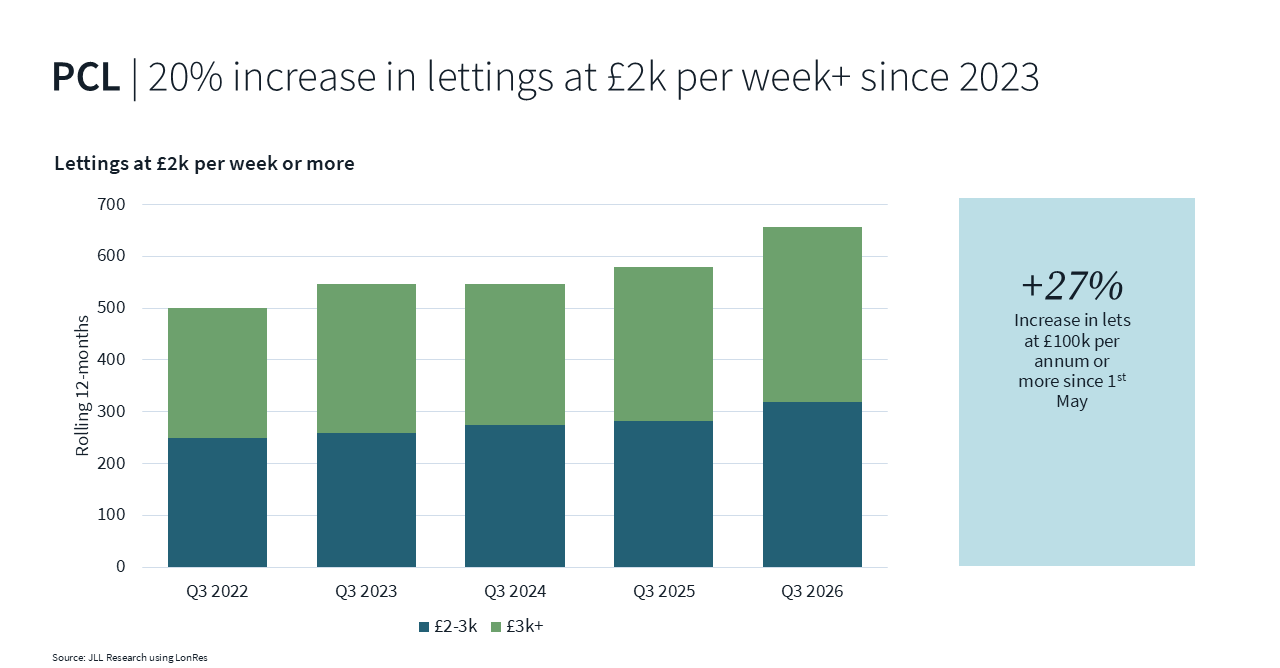
Wealthy international buyers haven't left, but many are choosing to rent while the UK's economic and political outlook remains uncertain. This helped push the annual number of homes let at more than £3,000 a week up 14 per cent year-on-year. Lettings above £100,000 a year, which are exempt from the Renters' Rights Act, rose 22 per cent annually, and monthly lettings in that bracket have run 27 per cent above the January to April average since the Act came into force on 1 May.
The market below £2 million, making up 68 per cent of Q3 sales, faces different pressures. This sector of the prime market is driven largely by domestic buyers, but with Moneyfacts reporting average two- and five-year fixed rates close to 6 per cent in October we expect demand there to remain subdued through year-end, or the point at which rates settle and start to become more attractive.
JLL’s Residential and Living team consists of over 300 professionals who provide a comprehensive end-to-end service across all residential property types, including social housing, private residential, build to rent, co-living, later living, healthcare and student housing.
Disclaimer: © 2026 Jones Lang LaSalle IP, Inc. All rights reserved. Data within this report is based on material/sources that are deemed to be reliable and has not been independently verified by JLL. JLL makes no representations or warranties as to the accuracy, completeness or suitability of the whole or any part of the report which has been produced solely as a general guide and does not constitute advice. No part of this publication may be reproduced or transmitted in any form or by any means without prior written consent of JLL. JLL, its officers, employees shall not be liable for any loss, liability, damage or expense arising directly or indirectly from any use or disclosure of or reliance on such report. JLL reserves the right to pursue criminal and civil action for any unauthorized use, distribution or breach of such intellectual property