The Bank of Japan has raised interest rates to 1.25 per cent, a 31-year high. This follows similar moves from the Federal Reserve, which increased rates this week for the first time in more than three years, rising to 3.75 per cent to 4 per cent. The European Central Bank is in a hawkish mood too, increasing rates by 25 basis points at their September meeting, the second rate rise since June.
Following the September meeting, the Monetary Policy Committee held the UK Bank Rate at 3.75 per cent, with the number of doves remaining at six and the hawks (favouring tighter economic policy and higher rates) at three. Despite the position remaining the same as at their last meeting, expectations of a rate hike, fuelled by comments from the Governor Andrew Bailey that “policy may have to tighten”, mean focus has now shifted to the next meeting (post-Budget) on 5th November. This all appears to leave the Bank of England as the outlier. But it is important to remember that the UK went into this at a different point in the rate-cutting cycle, with the differential between the UK and ECB rates widening since mid-2024 as they cut rates earlier.
 Source: Bank of England
Economy
High oil and energy costs (both a global, not just local, issue) are feeding into higher inflation. The latest CPI figures show the annual rate rising from 2.9 per cent to 3.1 per cent. This wasn’t a surprise for economists, but with inflation expected to exceed 4 per cent by early 2027, double the Bank’s 2 per cent target, it cannot be as easily dismissed as the blip some had hoped for.
As a result, swaps and mortgage rates remain elevated. Moneyfacts figures show average rates on two-year fixes at 5.77 per cent, the highest since May, and five-year fixed rates reaching 5.83 per cent, a level not seen since November 2023.
But another announcement from the Bank of England, this time in relation to gilts, is more welcome. The announcement that the Bank will pause all bond sales for six months or more and hold onto some of its longest-dated gilts was welcomed by the markets. As a result, 30-year gilt yields fell 0.12 percentage points to reach 5.74 per cent, marking the best day for markets since May and some much-needed relief from higher borrowing costs
Housing market
Rents rose nationally by 3.8 per cent in the 12 months to August, the highest annual increase so far this year. All regional markets except the South East saw rents rise at rates above-inflation, with the North East and North West both recording the highest annual increase at 5.8 per cent. In the sales market, just two regions (North East and North West) saw above inflation increases, nationally, prices rose 1.4 per cent, with London and the South West both seeing price falls of -3.3 per cent and -0.2 per cent respectively.
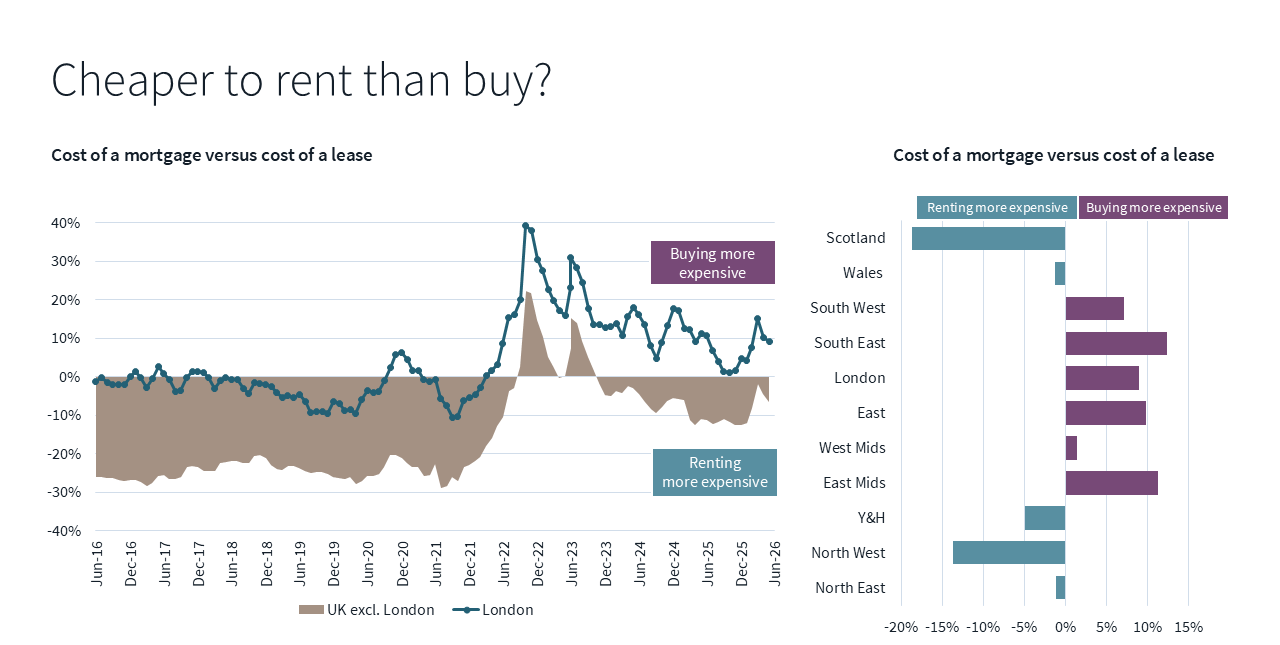 Source: JLL Research using HomeLet, ONS, Bank of England – assumes two-year fix at 75% LTV
Rent or buy?
Higher mortgage costs mean that in pricier markets the difference in cost between buying and renting a home is increasing. In London, where almost a third of homes are rented privately, it would cost on average 9 per cent more to buy a home rather than rent, based on average values. This compares with the period pre-2022 when buying a home with a 75 per cent loan-to-value mortgage was broadly the same cost. While some buyers could in theory bridge the monthly cost gap to buy a home, the ability to save a deposit remains a significant barrier. The average deposit for those looking to put down 25 per cent would be almost £139,000, the equivalent of saving more than five years’ rent. Even at a 10 per cent deposit, prospective buyers would need to save the equivalent of two years’ rent.
Housebuilding
Barratt Redrow, the UK’s largest residential developer, has trimmed its annual completion target to 17,500–17,900 homes, down from earlier guidance of 17,700–18,200. This follows an improvement in housing delivery in the year to June, with 17,667 homes delivered, up 5 per cent on the previous 12-month period. Chief Executive David Thomas pointed to resource-strapped local authorities as one of the reasons behind their expectations of a reduction in output over the coming year, with site opening delays limiting the group to around 405 active developments this year.
The financials painted a mixed picture. Statutory pre-tax profit jumped 48 per cent to £363.5m, but adjusted profit slipped 7 per cent to £572.8m as construction costs climbed and house prices edged down roughly 1 per cent. Still, the adjusted profit figure beat analyst expectations, sending shares up 11.7 per cent.
JLL’s Residential and Living team consists of over 300 professionals who provide a comprehensive end-to-end service across all residential property types, including social housing, private residential, build to rent, co-living, later living, healthcare and student housing.
Disclaimer: © 2026 Jones Lang LaSalle IP, Inc. All rights reserved. Data within this report is based on material/sources that are deemed to be reliable and has not been independently verified by JLL. JLL makes no representations or warranties as to the accuracy, completeness or suitability of the whole or any part of the report which has been produced solely as a general guide and does not constitute advice. No part of this publication may be reproduced or transmitted in any form or by any means without prior written consent of JLL. JLL, its officers, employees shall not be liable for any loss, liability, damage or expense arising directly or indirectly from any use or disclosure of or reliance on such report. JLL reserves the right to pursue criminal and civil action for any unauthorized use, distribution or breach of such intellectual property